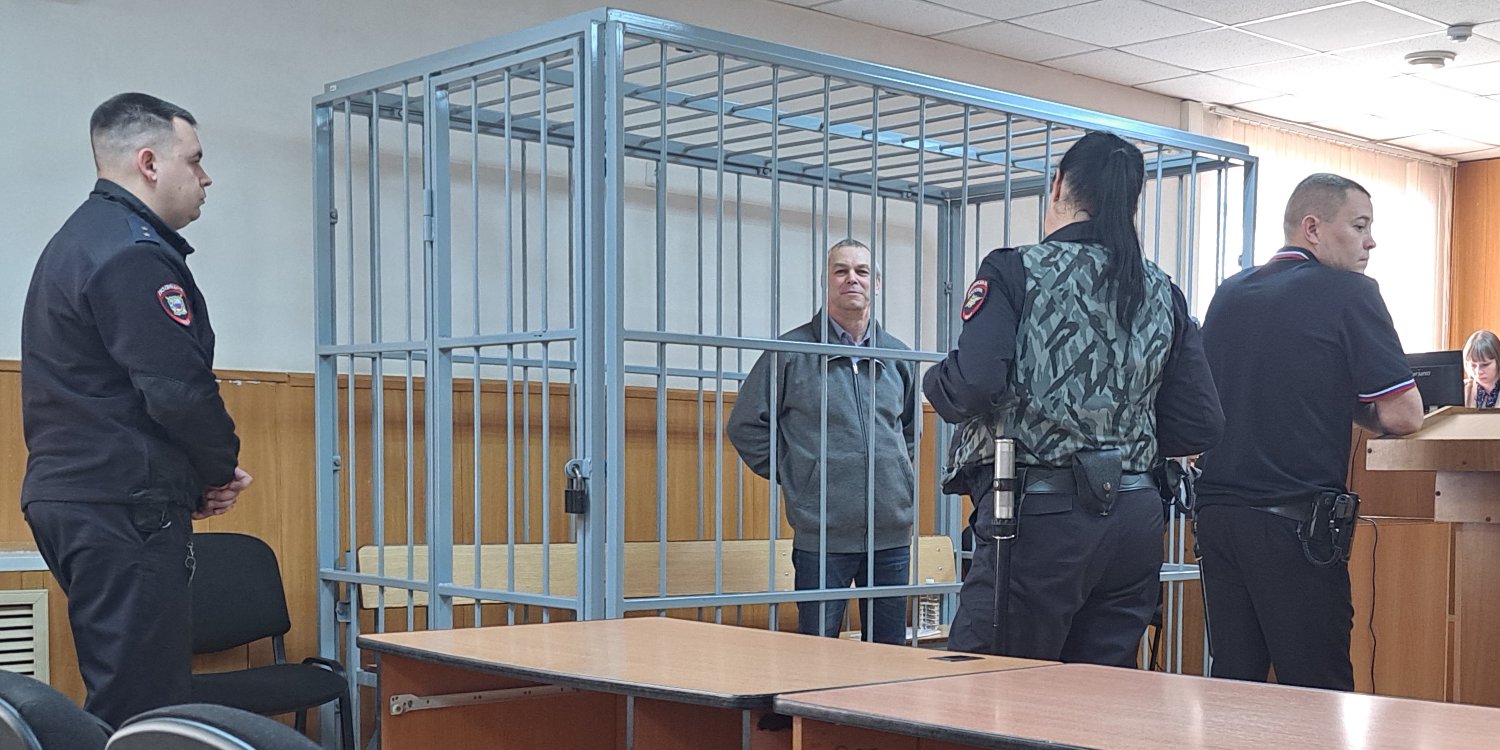
Oleg Postnikov on the day the verdict was announced. During the hearings he was kept in a cage. February 12, 2026.
Oleg Postnikov on the day the verdict was announced. During the hearings he was kept in a cage. February 12, 2026.
“Ordinary People”: Oleg Postnikov — One of Jehovah’s Witnesses — Sent to Penal Colony in Second Case for His Faith
Jewish Autonomous AreaJudge Vasilina Bezotecheskikh of the Birobidzhan District Court announced the verdict against Oleg Postnikov on February 12, 2026 — 6 years and 2 months in a penal colony. Earlier, the same court had given Oleg and his wife, Agnessa, suspended sentences on similar charges.
The Postnikovs have lived in Birobidzhan since the late 1980s. Oleg has several trades and has worked as a plumber for more than 15 years. In his youth — before becoming one of Jehovah's Witnesses — he became involved with a gang and ended up in a penal colony. According to Oleg, it was studying the Bible that helped him abandon his destructive lifestyle for good.
Exactly 6 years ago, on February 12, 2020, criminal charges were brought against Oleg and his wife for their faith. Years of investigation and multiple rounds of court proceedings ended in a guilty verdict. Just a few months after the sentence entered into force, their home was searched. The following year it happened again, another criminal case against Oleg was initiated and he was placed in a detention center.
"Since I remain one of Jehovah's Witnesses, I understand that the court may well refuse to protect me," Oleg said in his final statement. Anticipating a harsh sentence, he also shared his personal concerns: "It pains me that simply because I believe in God differently than others, my dear wife — my companion for 36 years — may be separated from me for many years."
The prosecution's main evidence consisted of video recordings of meetings for worship. "After almost a full year of covert filming, the FSB managed to select only a handful of meetings they considered the most 'extremist,' which rather show that we are ordinary people who respect everyone without exception," Oleg said. He paid special attention to one recording included in the case file: "A telling example is the closing prayer in which those present ask for strength to endure the hardships caused by persecution. There is no request for punishment or harm to our persecutors. Jehovah's Witnesses would never wish such a thing on anyone."
Both criminal cases against Postnikov were initiated by investigator Dmitriy Yankin, known for his conveyor‑belt approach to prosecuting believers. He has already brought more than 20 cases against Jehovah's Witnesses. Recalling the recent wave of repression in Birobidzhan, Oleg noted in court: "The case files contain orders to initiate criminal proceedings against six citizens. Who are they? Ordinary people: raising children, kept their families together, conscientious workers, they have no enemies, well‑regarded by everyone around them. Exactly the same, identical, as it was with me."
In total, 32 Jehovah's Witnesses have already faced criminal prosecution for their faith in the Jewish Autonomous Region.
